Responding to allegations of illicit or illegal practices
About this guide
This protocol for responding to allegations of illicit or illegal practices in intercountry adoption has been developed by the Australian Central Authority (ACA) in consultation with each State or Territory Central Authority (STCA). It will be reviewed regularly to ensure it adheres to best practice in preventing and addressing illicit or illegal practices in intercountry adoption.
The protocol can be applied if concerns or allegations about illicit and illegal adoption practices are raised.
The protocol provides information and assistance to adoptees and adoptive families in circumstances where there are suspicions or concerns about the legality of an adoption. This could include where there have been allegations or concerns about illicit or illegal practices related to the intercountry adoption of a child or children to Australia.
In Australia, intercountry adoptions are facilitated under the Hague Convention on Protection of Children and Co-operation in Respect of Intercountry Adoption(Opens in a new tab/window) (Hague Convention). The Hague Convention is an international treaty that protects children and their families against illegal, irregular, premature or ill-prepared adoptions abroad. It seeks to ensure the rights and best interest of the child are central to any decisions made about a child’s adoption. It also seeks to prevent the abduction, the sale of, or trafficking of children.
The ACA and STCAs also refer to the Hague Conference on Private International Law Toolkit for Preventing and Addressing Illicit Practices in Intercountry Adoption(Opens in a new tab/window). This provides guiding principles and preventative measures regarding illicit and illegal practices.
The ACA and STCAs are aware of the risks involved in intercountry adoption and only partner with countries who adhere to the principles and standards of the Hague Convention.
Using the protocol
The protocol supports Australian adoptees and adoptive families who have concerns about whether an adoption was done legally.
It does not apply to:
- cases where Australian adoptive parents may have acted wrongly
- expatriate adoptions (handled by the overseas country and local law enforcement).
If you have concerns about an expatriate adoption, you should raise this with the authorities in the overseas country that facilitated the adoption and with law enforcement authorities where appropriate.
The protocol is only a guide. Every intercountry adoption is unique and the needs of each adoptee, adoptive family and birth family will vary.
We understand that as an adoptee or adoptive family with concerns about an adoption, you may choose to undertake your own enquiries, without assistance from the ACA or your STCA.
Illicit and illegal practices
Illicit practices happen when a child has been adopted without respect for the rights of the child or for the safeguards of the Hague Convention. This may happen when an individual or body, directly or indirectly:
- misrepresents information to the biological parents
- falsifies documents about the child’s origins
- abducts, sells, or traffics a child for intercountry adoption
- uses other fraudulent methods to adopt a child for financial or other gain.
An illegal adoption is an adoption that results from the abduction, sale, or trafficking of a child or other illegal or illicit activities against children.
How to raise a concern
Concerns about an adoption can be upsetting. It’s important to remember that the rights and best interests of the adoptee are central, as well as the need for sensitivity for both Australian adoptive parents and overseas birth families.
We take all credible allegations or concerns seriously and are committed to maintaining the integrity of Australia’s intercountry adoption programs.
Suspicions of illicit or illegal practices may arise through various circumstances, including:
- observations of irregularities in intercountry adoption cases
- comments made by an adopted child about their background
- concerns about an ongoing, or already finalised, intercountry adoption raised by an adoptee, an adoptive family, birth family, prospective adoptive parents, an authority, a community member or anyone related to that adoption
- reviews or investigations conducted by authorities or accredited bodies in a country of origin, receiving country international organisations, or other
- monitoring, supervision and audits of overseas Adoption Accredited Bodies
- media reports
- legal proceedings
- law enforcement activity
- DNA testing
- searches for origins.
Contact STCA or ACA
If you have concerns about the circumstances of your or your child’s adoption you can:
- contact the STCA that handled the adoption first
- email the ACA at icaprograms@dss.gov.au.
Please note that where concerns are raised with the ACA, it may be necessary to work closely with the relevant STCA that handled the adoption. You should advise the ACA if you do not wish for this collaboration to occur. However, this may impact the ACA’s ability to investigate your concerns.
The ACA and STCAs take allegations or concerns of illicit and illegal practice seriously and will record suspicions brought to their attention. The ACA may also use diplomatic channels to raise such concerns.
Contact alternative authorities
If the concerns relate to the practices of the ACA and/or STCA, or you do not feel comfortable raising your concerns with the ACA or STCA, you can visit:
- Commonwealth Ombudsman(Opens in a new tab/window) or call 1800 362 072
- States and territories:
- ACT Ombudsman(Opens in a new tab/window)
- Ombudsman New South Wales(Opens in a new tab/window)
- Ombudsman NT(Opens in a new tab/window)
- Queensland Ombudsman(Opens in a new tab/window)
- Ombudsman SA(Opens in a new tab/window)
- Ombudsman Tasmania(Opens in a new tab/window)
- Victorian Ombudsman(Opens in a new tab/window)
- Ombudsman Western Australia(Opens in a new tab/window)
- Australian Federal Police(Opens in a new tab/window) (AFP) or call 13 14 44
Reports may be made to the AFP at any point, by the reporting party, the STCA or the ACA. The AFP play a key role in investigating international crimes, including through specialised taskforces and operations targeting issues such as child trafficking, which may be identified through illegal intercountry adoption practices.
What happens when a concern is raised
The ACA and STCAs have clear responsibilities when a concern of illicit or illegal practices is raised.
Any personal information you share with the ACA and STCAs will be handled in accordance with the Australian Privacy Principles(Opens in a new tab/window) and jurisdictional privacy laws. Please note that each jurisdiction has its own privacy laws.
ACA responsibilities
To ensure suspected cases of illicit or illegal practices are handled appropriately, the ACA will:
- explain the process for handling matters of illicit practices
- gather relevant information from the impacted person or authority that has reported the matter
- record and preserve disclosed information, to prevent impacted persons from having to provide the information repeatedly
- initiate (or ask the relevant authority to initiate) an investigation as soon as possible, in coordination with the relevant authorities, to determine whether the illicit practice occurred, if so, then determine what action/s may be required
- establish channels of communication with STCA counterparts to discuss possible illicit practices, exchange information on a regular basis about how to facilitate the disclosure of illicit practices and how to prevent and address them
- provide referral information to the person who has reported the matter to enable further investigation
- provide referral information to the person who has reported the matter for appropriate support and services
- designate a contact person (or persons) within the ACA
- if appropriate, recommend that the other State involved (the State of origin or the receiving State) investigate whether the adoption was lawful in their State, to prevent the illicit practice from happening again.
STCA responsibilities
The STCA officer will be responsible for:
- facilitating the disclosure of illicit practices by any interested person, authority or body. The STCA can discuss the disclosure with the ACA and/or relevant overseas authority. Where appropriate, the ACA will facilitate disclosure to the overseas authority on behalf of the STCA.
- verifying information against their records and maintaining an Issues Register, used to track reports of illicit or illegal practices
- initiating an investigation as soon as possible, in coordination with the relevant authorities to determine whether illicit practices may have occurred and, if so, what action/s may be required
- providing updates to relevant people about the progress of their enquiries
- alerting law enforcement authorities (for example, the AFP) where criminal activities are suspected
- liaising with relevant counterparts within a specified State throughout the process of responding to the illicit practice
- liaising with the ACA regarding the investigation, progress and outcomes
- contacting the adoptee, adoptive family and/or birth family if the suspected illicit practice came to the attention of the STCA without their knowledge
- the STCA officer will employ trauma-informed practices, including referral to appropriate support services such as counselling.
Please note, STCAs are expected to conduct investigations within their scope of capabilities, including gathering relevant files and evidence, reviewing files for information or patterns of concern, liaising with overseas adoption agencies where appropriate, and referring matters to the ACA. Additional information about how the STCA, and dedicated officer, will handle reports of illicit or illegal practice is further detailed in each STCA’s jurisdictional support guide.
Review of adoption documentation
When a concern regarding the circumstances of an intercountry adoption is raised, the STCA will review the adoption file for possible irregularities. This includes identifying information about the adoptee and all parties involved, however, some files may have limited documentation and/or information. After reviewing the file, the STCA will decide if there are irregularities or information that require further action.
If concerning information is identified, this doesn't necessarily mean that illicit or illegal adoption practices have occurred. Conversely, even if a review of the adoption documentation doesn’t suggest irregularities, further enquiry may still be needed, including to see if any patterns arise.
If an adoptee, adoptive family or birth family raised the concerns, they will be advised of the outcome of the STCA’s review of the documentation.
The STCA will advise the ACA of all concerns regarding an adoption, regardless of the outcome of the STCA review. Non-identifying information about the adoption will be used for record-keeping purposes and trend monitoring as part of the ACA’s role under the Hague Convention.
Further action or enquiry
If the relevant STCA decides that further action is needed, they will refer the concern/allegation to the ACA for action. Where a concern is raised with the STCA directly, the STCA will only provide non-identifying details to the ACA.
Generally, a STCA will need the consent of the adult adoptee or adoptive family (if the matter is raised on behalf of their adopted child who is under 18) to share identifiable information with the ACA. Where consent is not granted, the ACA will have limited ability to enquire into the adoption.
Where credible concerns or allegations of illicit or illegal practices are identified, the ACA will request that the relevant overseas authority make appropriate enquiries into the circumstances of the adoption. The country of origin and receiving country’s Central Authorities are both obliged to work together to eliminate obstacles to the Hague Convention’s application where it’s suspected that provisions of the Hague Convention have not been respected.
While the ACA endeavours to raise concerns and proactively seek responses, the ACA is not able to influence the decisions of a Central Authority in a country of origin to investigate matters referred to them. Responses provided by overseas authorities may be influenced by factors such as the time that has elapsed since the adoption took place, availability of records and information about the adoption, or the need to liaise with other adoption or law enforcement agencies.
Contact and confidentiality
A dedicated officer from the relevant STCA and the ACA will be appointed to act as the primary contact for providing updated information about the progress of enquiries or responding to further questions or concerns relating to reports of illicit or illegal practices.
The STCA officer will be the primary contact for the adult adoptee and/or adoptive family and the ACA officer will fulfil the Commonwealth’s coordination, management and policy responsibilities as well as communicate with the relevant authorities in the country of origin.
Making your own enquiries
Adoptees and/or adoptive families can choose to make private enquiries about concerns of illicit or illegal practices, through police or other channels. This may occur in addition to, or instead of, formal enquiries made through the ACA and/or the relevant STCA.
The Australian Government cannot assist an adoptee or adoptive family with adoption enquiries while they are overseas.
Where private enquiries are pursued, the ACA and the relevant STCA should be notified of any concerns of illicit or illegal practices identified as a result of these enquiries, as there may be broader program implications.
Individuals should exercise caution when hiring individuals or agencies to conduct investigations overseas.
Broader program implications
Where credible concerns are raised about an adoption (from a particular adoption agency or country of origin), the ACA and relevant STCAs, will consider possible broader implications for the operation of the intercountry adoption program. Depending on the circumstances, this may involve a range of actions including:
- putting adoptions with specific adoption authorities or agencies on hold while enquiries are undertaken
- suspending a program, pending further enquiry
- limiting new applications
- formally closing a program.
Where credible concerns are raised, an assessment will be made about the likelihood of other adoptions being subject to similar practices. Discussion between the ACA and relevant STCAs may be required to determine whether to contact other families who may have also been affected.
Support and assistance
The Protocol aims to provide broad guidance on information and services that an adoptee or adoptive family may wish to access. It recognises that everyone’s needs are different.
In addition to the support services listed below, STCAs also have post-adoption services and supports available for adoptees and their families. More information is available in each STCA Jurisdictional Support Guide. It is recommended adoptees and their families contact the relevant STCA to discuss the range of supports available.
Therapeutic support services
The Intercountry Adoptee and Family Support Service(Opens in a new tab/window) (ICAFSS) is a free, national, counselling and support service for the intercountry adoption community. It provides post‑adoption support for adoptees and families formed by intercountry adoption.
Adoptees and adoptive parents impacted by suspected or confirmed illicit or illegal practice can access the ICAFSS by contacting the Intercountry Adoption Support Team on 1800 422 377 or via email at icafss@rasa.org.au.
Local and community support services
Learn more about Intercountry adoption support and Community, peer and advocacy groups.
Legal issues
The ACA and STCAs are unable to provide legal advice to individuals. The Law Society in each state or territory may be able to provide a referral to a legal practitioner with experience in family law or children’s issues.
Lawyers seeking general reference material on intercountry adoption may wish to refer to Intercountry adoption.
Financial assistance, legal and other related costs
The Attorney-General’s Department(Opens in a new tab/window) administers schemes for legal costs and disbursements that may be available, depending upon the circumstances of the case.
Managing media attention
Intercountry adoption regularly attracts media attention. Concerns about illicit or illegal practices may be raised in the media, which can present additional challenges. If this does occur and assistance is required in managing the media interest, the relevant STCA contact officer may be able to assist, along with counselling supports such as those offered by the ICAFSS(Opens in a new tab/window).
Jurisdictional support guides
STCAs have developed jurisdictional support guides to complement the protocol. They provide jurisdiction-specific information to assist STCAs in responding to concerns or allegations of illicit or illegal practices in intercountry adoption. The support guides provide more detailed information about how each STCA responds to reports of illicit or illegal practice.
The support guides also contain information about relevant authorities and support services adoptees and their families can engage with on intercountry adoption-specific issues.
Each support guide will be published on the relevant STCA website and can be accessed via the relevant state or territory.
Support guides available as at October 2026:
- Queensland: Department of Families, Seniors, Disability Services and Child Safety(Opens in a new tab/window)
- South Australia: Department of Child Protection(Opens in a new tab/window)
- Tasmania: Department for Education, Children and Young People(Opens in a new tab/window)
- Victoria: Department of Justice and Community Safety(Opens in a new tab/window)
- Western Australia: Department of Communities(Opens in a new tab/window).
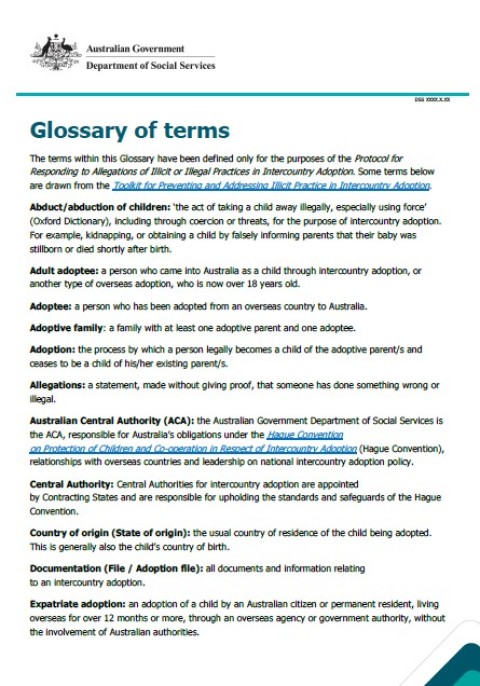
Protocol resources
These resources may help if you have a concern about an adoption.
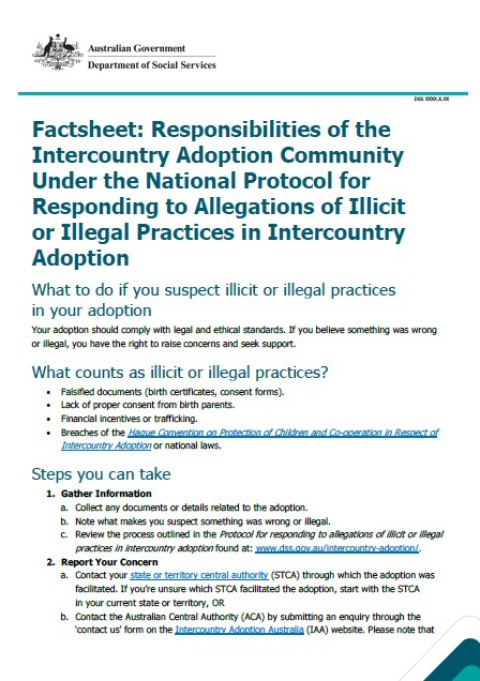
Factsheet: Responsibilities of the Intercountry Adoption Community Under the National Protocol for Responding to Allegations of Illicit or Illegal Practices in Intercountry Adoption